Discover how solar particles create the Northern Lights and why Rovaniemi is an ideal place to see the Aurora Borealis.
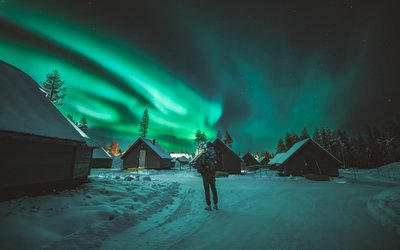
The Northern Lights, also known as the Aurora Borealis, are one of the most spectacular natural phenomena you can experience in Lapland. But how do those green, purple and sometimes red lights actually appear in the night sky?
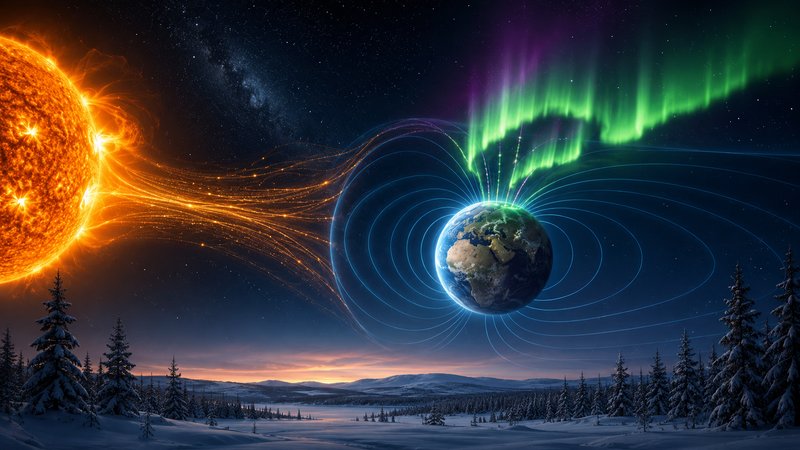
The story begins around 150 million kilometres away, at the Sun.
It All Starts With the Sun
The Sun constantly releases electrically charged particles into space. This stream of particles is known as the solar wind.
When solar activity becomes stronger, larger amounts of these particles can travel towards Earth.
Our planet is protected by a magnetic field, which directs many of these charged particles towards the polar regions.
This is why places close to the Arctic Circle, including Rovaniemi and Finnish Lapland, are excellent locations for seeing the Northern Lights.
What Happens When the Particles Reach Earth?
When charged particles from the Sun enter the upper atmosphere, they collide with gases such as oxygen and nitrogen.
These collisions release energy in the form of light.
The colour of the Aurora depends on which gases are involved and how high above Earth the interaction takes place.
Green is the most common Northern Lights colour and is mainly produced by oxygen.
Red Aurora can also be created by oxygen at higher altitudes, while nitrogen can produce blue and purple tones.
Why Do the Northern Lights Move?
The Aurora can appear as soft glowing arches, curtains, waves or fast moving shapes across the sky.
This movement is caused by constantly changing interactions between solar particles, Earth's magnetic field and the atmosphere.
Sometimes the Aurora may appear weak and almost motionless. On more active nights, the sky can suddenly become filled with rapidly moving curtains of light.
Every Aurora display is different.
Why Is Rovaniemi a Good Place to See Them?
Rovaniemi is located close to the Arctic Circle and within a region where Aurora activity can frequently be visible during the darker months.
However, Aurora activity alone is not enough.
You also need dark skies and clear weather.
Clouds can completely block the Northern Lights even when strong Aurora activity is happening above them.
This is why experienced Aurora hunting involves monitoring not only solar activity, but also cloud coverage and changing weather conditions.
When Can You See the Northern Lights in Rovaniemi?
The Northern Lights season in Rovaniemi generally runs from late August until early April, when the nights are dark enough to see the Aurora.
There is never a guaranteed time or exact moment when they will appear.
Some nights bring only a faint glow, while others can produce powerful displays that fill the entire sky.
That unpredictability is part of what makes seeing the Aurora Borealis so special.
Experience the Aurora Borealis in Lapland
Understanding the science behind the Northern Lights makes the experience even more fascinating, but nothing compares to seeing them with your own eyes.
During our Northern Lights Tour from Rovaniemi, our experienced guides monitor real time Aurora activity, weather conditions and cloud coverage throughout the night.
Instead of relying on one fixed viewing location, we search for the best possible conditions and travel towards clearer skies when necessary.
When the Northern Lights appear, we also capture your experience using professional cameras and dedicated astrophotography lenses, so you can take home high quality memories of your night under the Arctic sky.
The science behind the Aurora Borealis is incredible.
Seeing it happen above you in Lapland is something completely different.